Help people find relevant mentors
AI Mentor Matcher
Help mentees search by their career goals, even when a mentor describes their experience using different words.
Outcome
Built a search prototype that considers meaning as well as exact keywords and keeps an alternative search path available.
My role
AI Developer
How I helped
- Designed matching around career context.
- Built the mentor search process.
- Added an alternative when the main search service is unavailable.
Product
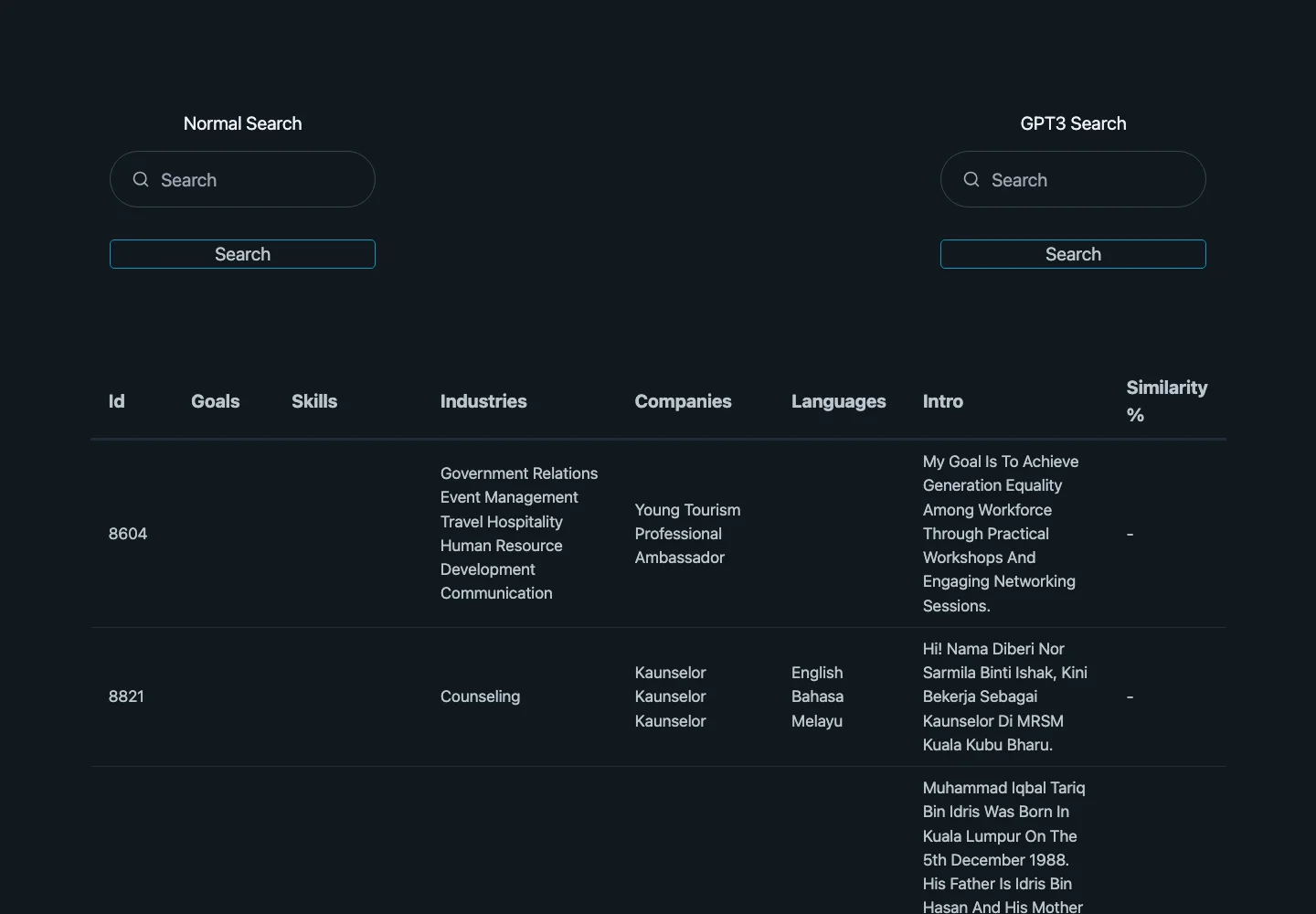
The workflow in context
Captured from the public prototype in September 2026.
The solution
Compare what a mentee needs with the experience mentors describe, rather than relying only on matching words.
What changed
A prototype supports context-based mentor search. A comparison of recommendation quality has not been published.
Lessons learned
Useful recommendations need to be evaluated against what people actually find helpful.
Behind the solution
Traditional keyword matching fails when mentors and mentees use different terminology for similar concepts or career aspirations.
A serverless Next.js App Router project queries PostgreSQL using Prisma. Search queries are mapped to embeddings on the fly and processed in the database via pgvector.
Constraints
- Keep response latency low for live searches.
- Support Prisma-compatible vector storage and similarity scoring.
- Mitigate API cost overhead of generating search query embeddings.
Technical decisions
- Used text-embedding-ada-002 for vector embeddings.
- Implemented raw SQL similarity queries through Prisma
$queryRaw. - Added a full-text fallback when database connections or API limits interrupt semantic search.
Key features
- Vector embedding search.
- Semantic similarity threshold controls.
- Full-text keyword fallback queries.
AI system implementation
OpenAI text-embedding-ada-002 converts search queries into vectors. PostgreSQL pgvector performs similarity search through Prisma raw SQL, with configurable thresholds and a full-text fallback when semantic search is interrupted. This is retrieval-based matching, not a conversational agent. Recommendation-quality comparisons have not been published.
Could a similar approach help your business?
Tell me where work gets stuck. We can identify a practical first improvement and what success should look like.
Discuss your challenge